 |
Chapter 4 |
Equity by industry
Industries reveal different equity strategies
Employee share plans are common across Hong Kong-listed companies, but the way organisations use them varies significantly by industry.
Talent pressures, workforce needs, growth priorities, and business models all influence how companies design and use equity incentives. As a result, industry practices can provide valuable benchmarks for boards, remuneration committees, and HR leaders evaluating whether their own approach supports their business objectives.
The data shows that organisations facing different challenges often adopt different equity strategies. Understanding those differences can help companies make more informed decisions about plan design, retention, performance, and long-term alignment.
Organisations competing for specialist talent often use more sophisticated equity structures
Industries facing intense competition for skilled employees frequently place greater emphasis on long-term retention and alignment.
Healthcare and technology organisations are among the strongest examples. These sectors rely heavily on specialist talent, operate in highly competitive labor markets, and often have longer time horizons for value creation.
As a result, they are more likely to use equity strategically to retain key employees and align them with long- term company performance.
Plan adoption by Industry
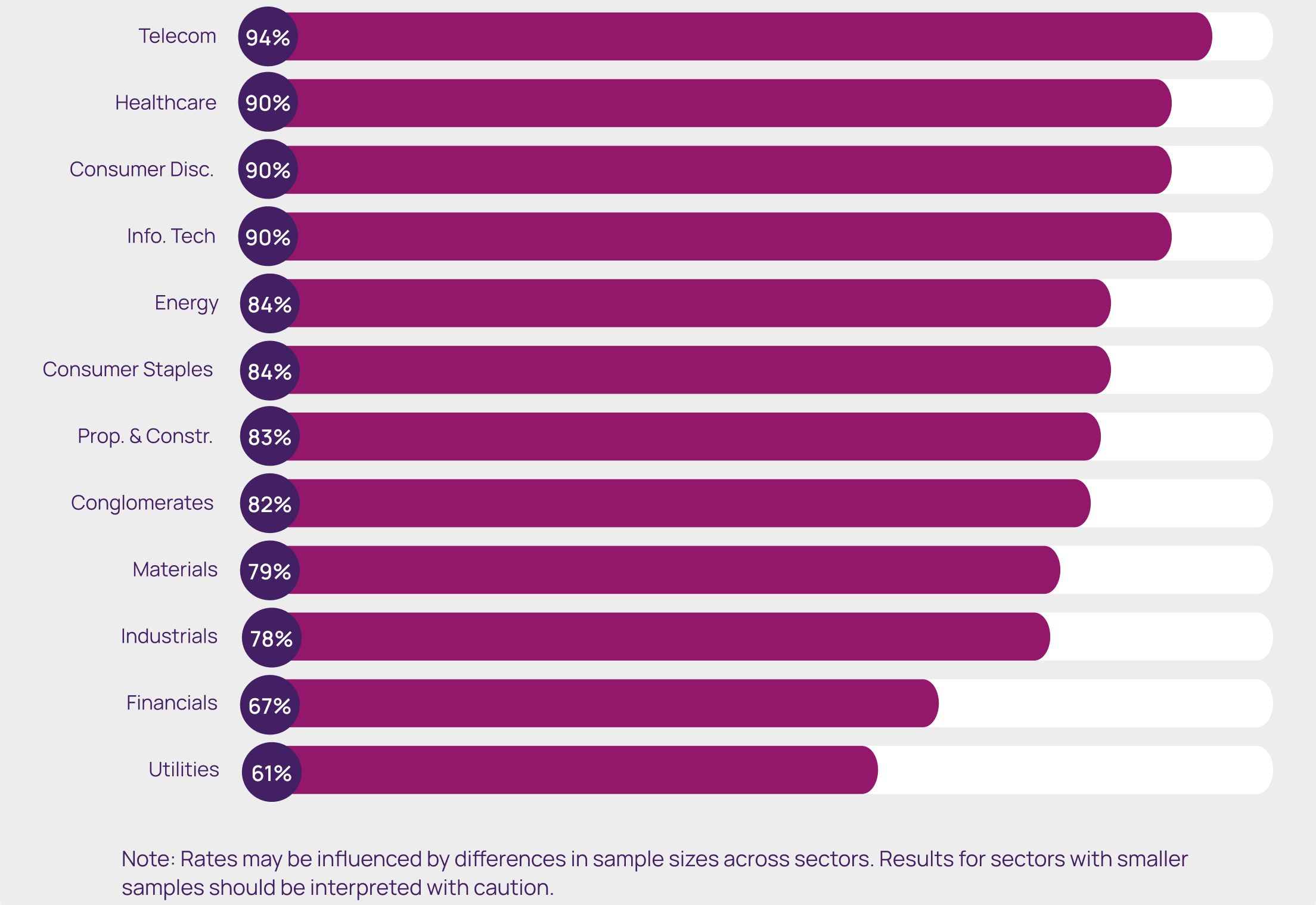
Average adoption
Adoption among top-adopting sectors
Lowest adoption sector
Highest adoption sector

What this means?
Companies competing for scarce or highly specialised talent may need different incentive structures than organisations operating in broader labor markets.
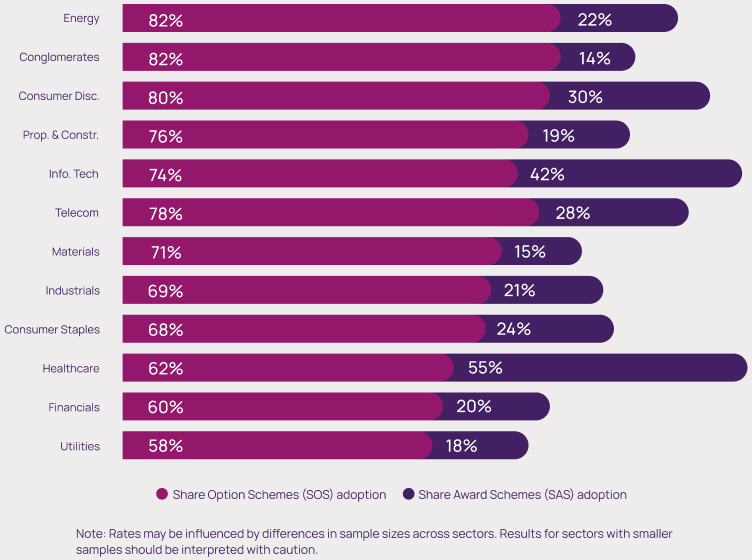
The stronger use of share awards in healthcare and technology suggests that retention and long-term alignment can become more important as the competition for talent increases.
Different industries prioritise different objectives
The choice between share awards and share options can provide insight into what organisations are seeking to achieve. In some industries, equity is primarily used to create long-term retention and ownership. In others, the focus may be on rewarding growth, encouraging performance, or supporting executive alignment.
The differences suggest there is no universal model for effective plan design. Instead, many organisations appear to select plan structures based on their specific business requirements, workforce challenges, and growth priorities rather than simply following broader market practice.
Plan type by industry

What this means?
The choice between share awards and share options is often a reflection of business priorities rather than market convention.
Organisations should consider whether their current plan structure aligns with the outcomes they are trying to achieve. Industry differences suggest that leading companies are becoming more deliberate in matching equity design to workforce needs, growth objectives, and long-term strategy.
Market innovators provide an early indication of where the industry is heading
Some industries appear to adopt emerging practices earlier than others. Healthcare organisations, for example, demonstrate stronger use of retention-focused structures and are increasingly linking equity outcomes to business and operational milestones. Technology companies continue to refine how equity supports long-term talent attraction and retention.
While industry practices should not be copied directly, they can provide useful signals about how organisations are responding to changing workforce expectations and business challenges.

What this means?
Industry leaders can provide useful reference points when organisations are reviewing or redesigning their own plans. The goal is not to replicate competitor approaches, but to understand how other organisations address similar challenges.
The key lesson for decision-makers
The strongest industry benchmark is not necessarily the one with the highest adoption rate or the most generous awards. The more useful question is what business problem is this equity strategy designed to solve?
The findings suggest that organisations are increasingly tailoring equity plans to their specific workforce needs, growth objectives, and business priorities. Industry differences therefore offer more than a benchmark. They reveal how organizations are using equity to support retention, alignment, performance, and long-term value creation in different ways.
Unlock Computershare's exclusive analysis
See how companies are tailoring equity plans to reflect industry-specific priorities and performance objectives.





Disclaimer: The services mentioned in this analysis are provided by Computershare's licensed corporation in Hong Kong. This analysis is provided for general information only.